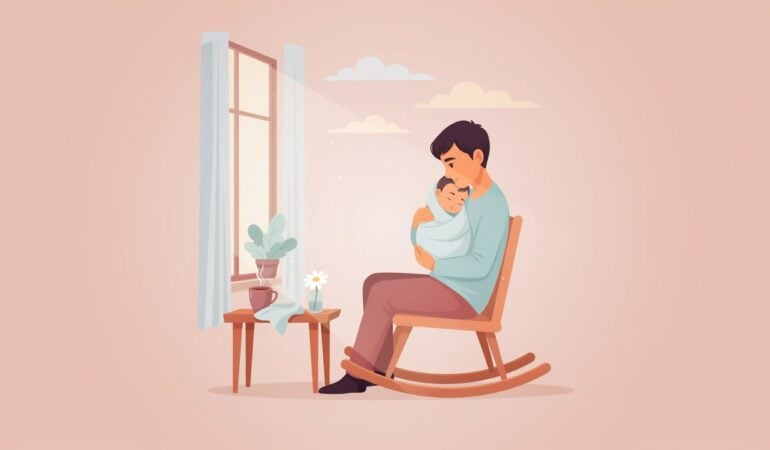
If you’re wondering whether men can get postnatal (postpartum) depression, let me start by saying this:
Yes, they absolutely can.
Just a shame people don’t talk about it enough.
When people hear the words postnatal depression, they immediately think of mums. And while mums are more likely to experience it, dads can have it too.
The problem is that many men don’t realise when they have it.
Most new mums don’t either, but they are at least aware it exists. Most men don’t know about postnatal depression (PPD) in men which makes it all the harder to recognise.
They think they’re just tired or stressed.
And they often believe they should be the “strong one” and hold it all together.
This is not true, and the more we talk about PPD In men, the sooner we can break the stigma and support more dads out there.
In this post, I cover:
If men can get postnatal depression
The signs and symptoms to look out for
Why it happens
What dads can do to recover
Let’s begin.
What is postnatal depression?
Postnatal depression is a type of depression that can happen after having a baby.
Most people think it only happens mums, but dads can experience it too.
Researches suggests that up to 1 in 10 dads develop postnatal depression during the first year after their baby is born.
Although these numbers only refer to reported cases, so the real number is likely much higher.
Postnatal depression has nothing to do with how much you love your baby or what kind of parent you are.
It doesn’t mean you’re weak or that you’re failing.
It’s a serious illness that needs professional treatment.
If you want to learn more about postnatal depression, check out also these posts:
Postnatal depression affects people regardless of gender.
Even adoptive parents can experience this (sometimes called post-adoption depression).
It happens because everything in life changes overnight: your routine, sleep, social life, identity, emotions.
Your brain needs some time to catch up.
In men, postnatal depression doesn’t always look the way you may expect.
Instead of crying or deep sadness, it can look like:
irritability
silence
shutting down
throwing themselves into work.
Some men become unusually short-tempered, easily frustrated, or emotionally distant.
Others cope by staying busy so they don’t have to sit with their feelings.
It can also look like:
numbness
not enjoying things
not feeling connected to the baby
feeling like they’re just going through the motions without really being in it
And then there is often the pressure on dads to provide financially and be the “strong ones”. So instead of saying “I’m struggling”, it often turns to “I’m fine” while everything inside feels heavy.
And this is exactly why PPD in men often gets missed.
Because when a dad is tired, works hard, doesn’t talk much and just tries to push through, it doesn’t always raise alarm bells.
People assume it’s just stress or sleep deprivation, and that he’ll be fine once life calms down.
They don’t realise there’s a name for what they’re feeling.
Signs of postnatal depression in men
Here are some of the common signs to look out for:
1. Emotional signs
A dad might:
Feel flat or like nothing really feels enjoyable anymore
Get overwhelmed by small things that normally wouldn’t bother him
Feel worried a lot, even about little things
Get irritated or angry more easily than usual
2. Changes in behaviour
You might notice he’s:
Spending more time at work or staying busy all the time
Pulling away from friends or family (or both)
Doesn’t want to talk about how he’s feeling
Using distractions (like screens, work, or going out) to switch off
3. Physical signs
Postnatal depression can also manifest in the body.
He may:
Be feeling tired all the time, even after sleeping or resting
Have trouble sleeping properly
Have headaches
Have low energy or no motivation
4. Bonding and connection
This is a big one, and people don’t really talk about it.
He might feel:
Disconnected from the baby
Like he’s just going through the motions
Guilty for not feeling how he “should”
Why it happens (causes and risk factors)
There is usually more than one reason when a dad struggles with postnatal depression.
One of the biggest reasons is – similarly to mums – the massive life change that comes with a baby.
Now you’re looking after a tiny human 24/7. You can’t call in sick or have a nap whenever you feel like it.
And when you’re exhausted for weeks or even months, everything feels harder.
Not just for mums, but for dads too. Even if they’re the one going to work and don’t spend all day with the baby, broken nights still take a huge toll on them.
2. Pressure to hold it all together
A lot of dads feel like they have to be the strong one. The one who supports their partner and keeps everything running.
So even when they’re struggling inside, they don’t say anything.
They worry they’ll let their wife or partner down.
Instead, they pretend they’re fine and keep pushing through.
And depression often thrives in silence.
3. Money and responsibility worries
Babies aren’t always as expensive as they are when they start growing up, but many dads naturally start worrying about the future.
What if I lose my job?
What if I can’t provide for my family?
What if something happens to me?
What if I’m not a good enough dad?
These thoughts can sit quietly in the back of their mind and can make them feel stressed.
4. A huge identity shift
Becoming a parent is big life change for both mums and dads.
Suddenly, you’re not just “you” anymore. You’re someone’s dad.
That’s amazing in many ways, but at first, it can feel overwhelming.
You’re now responsible for a tiny human who depends on you completely. That’s a lot for anyone to take in and it takes time to used to it.
5. Changes in the relationship
A baby often changes the relationship between partners.
You sleep less, you’re both more tired, you have less time together, and small disagreements can feel much bigger than they used to.
Many new mums naturally focus most of their attention on the baby, which is completely understandable. But some dads can start to feel left out or unsure where they fit in now.
I share practical tips on how to keep your relationship strong and healthy after kids in these posts:
Many dads struggle in the beginning, but if they talk openly to their partner, friends, or family, their feelings are likely to go away in a few weeks.
The problem is that many men don’t talk about them.
They often keep everything inside and hope it will settle with time.
Sometimes they do. But if those feelings stay bottled up for too long, they can grow into something much bigger, including postnatal depression.
Why postnatal depression often goes unnoticed in men
Most dads don’t realise when they have postnatal depression.
And the people closest to them don’t either.
So they rarely stop to ask themselves, “Could this be what’s happening to me?”
Men are also often raised to believe they should be strong, resilient, don’t cry, and push through problems.
So rather than admitting they need help, they tell themselves to keep going – to work harder, stop complaining, and to “man up”.
But mental health doesn’t quite work like that.
When you ignore or repress your feelings, they stay stored in your body and manifest in a form of mental or physical illness.
Another reason men miss the signs of postnatal depression is because it doesn’t always look like sadness – which is how most people imagine PPD to look like.
That’s why it’s very important to know the signs.
The earlier you spot the signs, the sooner you can get better.
What dads can do to get help
If you’re thinking, “This sounds a bit like me (or someone I know),” please know this:
You. are. not. weak.
And you are definitely not failing as a dad or a man.
Postnatal depression is a health condition, and just like any other health condition, it can get better with the right support.
Here are a few things that can help:
1. Talk to someone you trust
Choose someone you trust and tell them how you really feel.
It could be your partner, a friend, a family member, support group, or even a stranger… as long as they’re supportive.
Be careful who you open up to, because the wrong person can sometimes make you feel even worse.
If you can, talk to another dad who’s been through it.
There’s nothing like the feeling of realising you’re not alone, and that other people understand what you’re going through.
2. Speak to your GP or doctor
If these feelings have lasted for more than two weeks or are getting worse, it’s important to speak to your GP or doctor.
Many GPs have helped parents through postnatal depression before, and they’re there to support you.
That said, it’s also important to find the right doctor.
I’m sorry to have to say this, but I’ve heard too many stories from mums and dads whose concerns were dismissed or brushed aside by a doctor.
Sadly, not every healthcare professional recognises or understands postnatal depression.
If you don’t feel listened to or taken seriously, don’t give up.
Ask for a second opinion or speak to another GP.
Your feelings are valid and you absolutely deserve the right support.
3. Learn to ask for help
As a new parent, you do need help.
And the sooner you do, the better.
Most new parents resist asking for help for too long… until they break down.
But asking for help is actually your superpower.
Family, friends, neighbours, community group… take it all. The more the better.
Ask for a hot meal, a shop run, help with housework….
There’s a reason they say it takes a village. It really does.
4. Give yourself more love and compassion
It’s crucial that you stop blaming yourself for being unwell.
It’s not helping you, and it’s not helping your family either.
Now that you know postnatal depression in men is real and your feelings are valid, start talking to yourself the way you would talk to a friend who was going through the same thing.
Listen to your inner talk.
When you catch yourself thinking something unkind, pause for a moment and replace it with something more compassionate.
For example, if you catch yourself thinking,
“I’m not good enough.”
Stop and reframe it.
Try saying something like,
“I’m not failing. I’m going through a difficult time, and that’s okay. My feelings are valid, and I’m taking steps to get better. The fact that I care so much about my family shows just how much they mean to me.”
This is just an example, find the words that feel true to you.
5. Remember that the biggest changes happen in small steps
Right now, you probably feel like it’s never going to end. But I promise it will.
With the right support and the right people around you, you will recover from postnatal depression.
Don’t aim for big positive changes.
In other words, don’t try to take 50 steps at once.
Real healing happens in one small step – one improved feeling every day.
How to support a dad with postnatal depression
If you think your partner, son, brother, or someone close to you might have postnatal depression, the best thing you can do is let them know you’re there to support them.
Don’t try to:
fix them
cheer them up
talk “sense” to them
tell them to snap out of it or “man up”
What they need now is to feel seen and supported.
You don’t need to have the right words to say, you just need to be there, and listen whenever they need to talk.
Also, make sure to check on them regularly.
Even if they’re not saying anything, or showing no signs of PPD, it doesn’t automatically mean they are ok.
You can also encourage them to speak to their GP or another healthcare professional if they’re finding it hard to reach out for help.
If they don’t want to talk straight away, that’s okay.
Most men need to be asked more than once before they open up.
And most importantly: Let them know they’re doing a great job, and that you’re there for them.
Final word
There you go!
I hope this post helped you understand that postnatal depression can definitely happen to men, why it happens, and what you can do to recover.
Please know that you’re not overthinking it.
And you’re definitely not alone in this.
Postnatal depression in men is real – the only problem is that it’s not talked about enough.
In many cases, the hardest part isn’t the illness itself, but spotting the signs and reaching out for support.
If anything in this post has hit home, talk to someone.
I really can’t stress this enough.
And if you’re supporting someone who is struggling, don’t underestimate your role.
Having someone there for you when you feel at your lowest is one of the most powerful forms of support anyone struggling with mental health can have.
PhDr. Ivana Poku is the author of Motherhood – The Unspoken, an award-winning blogger and maternal mental health advocate. Through her work, she is on a mission to create a world where mums feel seen, heard and supported. Ivana is also a mum of three boys, including twins, and lives with her family in a small coastal town in Scotland.
PhDr. Ivana Poku is the author of Motherhood – The Unspoken, an award-winning blogger and maternal mental health advocate. Through her work, she is on a mission to create a world where mums feel seen, heard and supported. Ivana is also a mum of three boys, including twins, and lives with her family in a small coastal town in Scotland.
27 UPLIFTING AFFIRMATIONS FOR NEW MUMS
Download these FREE affirmations and feel lighter in seconds!