Last Updated on August 21, 2026 by Ivana Poku
I struggled with postpartum depression in 2016 after having my twin boys.
I had days when I couldn’t even get out of bed and brushing teeth felt like a huge task.
Everything felt pointless.
And I had thoughts that scared me the hell out of me.
If you’re in that place right now, I want you to know that you are not alone feeling this way.
Sometimes postpartum depression (PPD) doesn’t feel like sadness. You may feel like you’re stuck inside your own body, watching life happen around you but not really able to join in.
And that can be incredibly frightening and isolating.
But I want you to know this:
What you’re feeling right now doesn’t say anything about you as a mum or as a person. It’s an illness you can’t push through by pure willpower.
You may have had someone recommend antidepressants for you, or you may know in your heart that they could help you feel better. But you are scared to take them.
You worry that:
- they will impact your mind and body
- taking them will somehow mean you’re failing in a way
- they will impact your breastmilk (if you’re breastfeeding)
- you will get addicted to them
I had these same questions myself before taking antidepressants, that’s why I decided to write this post for you.
We’ll talk about:
- what antidepressants for postpartum depression actually are
- when they’re used
- what they feel like
- what I wish someone had told me when I was sitting where you might be now.
But first hello!
I’m Ivana, a mum of three boys (including twins), the founder of MumsJourney, and author of Motherhood: The Unspoken, on a mission to create a world where mums feel seen and supported.
After having our twins in 2016, I had severe postpartum depression (also known as postnatal depression or PPD). It was the worst time of my life I don’t wish on anyone. But it also helped me realise how many (new) mums struggle in silence.
After I recovered from, I started this blog to help other mums so they never feel alone in what they’re going through.
If you’re in the thick of depression right now, I highly recommend you read my book Motherhood – The Unspoken, where I share my full PPD story and how I recovered. I wrote it to help you to feel seen and supported, and show you the light at the end of the tunnel.

My experience with antidepressants
My postpartum depression started slowly and quietly.
At first, I felt incredibly lonely and sad. I didn’t enjoy my babies, and I missed my old life.
Today I know these are all common feelings for many new mums. But back then, I didn’t know that. I simply thought I was failing.
I felt ashamed that I wasn’t happy or enjoying motherhood, so I hid how I felt from the world.
The truth is, postpartum depression thrives in silence.
What started as natural feelings that many new mums experience after having a baby, slowly turned into a severe illness.
At one point, I genuinely believed everyone would be better off without me. I couldn’t see the point in anything anymore. I was just an empty shell.
By then, I already had antidepressants at home that my doctor had prescribed. But I felt too ashamed to take them.
I thought that if I was a good mum, I should be able to cope without medication.
Everything changed the day I felt a strong urge to hurt my son.
That was the moment I realised this wasn’t the time to play superhero. I needed help.
I started taking antidepressants that same day.
And the only thing I regret is not taking them sooner.
When they started to work, it felt like a huge cloud had lifted from my brain and my chest.
I finally had the space and strength to start healing.
And most importantly – I no longer had thoughts about harming myself or the babies.
I share my full PPD recovery story in my post How I Recovered From Postnatal Depression (And How You Can Too).
What are antidepressants for postpartum depression?
If you’ve never taken antidepressants, you probably picture them much scarier than what they really are.
But they are really nothing to be scared of, they are here to help you.
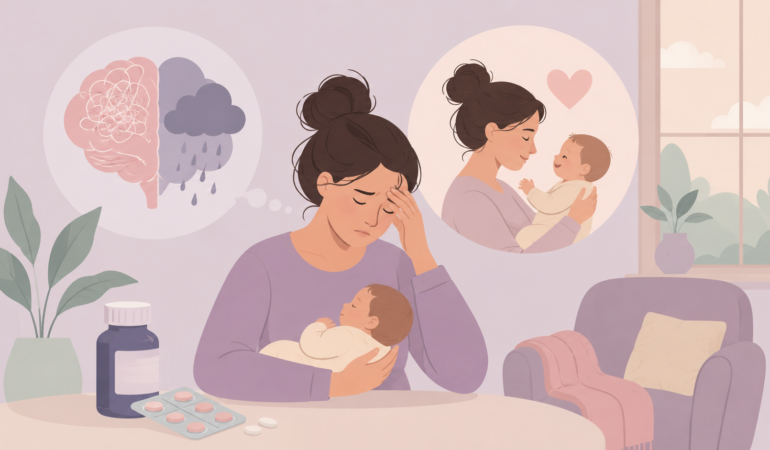
Antidepressants help balance the chemicals in your brain that affect mood, sleep, anxiety, and energy.
For many people, they can be life-changing and even life-saving.
They don’t erase your feelings or change who you are.
They simply take the edge off the symptoms you can’t control.
For postpartum depression, doctors most often use a type of antidepressant called SSRIs.
You may hear your doctor or GP talk about names like Sertraline, Fluoxetine, or Citalopram.
The choice is always made together with your doctor based on your specific situation.
If you’ve come across the term postpartum depression ICD-10, it refers to how postpartum depression is classified in the ICD-10 system.
I explain the postpartum depression ICD-10 code and what it means in this post.
When are antidepressants used?
Doctors usually suggest antidepressants when postpartum depression feels too heavy for you to manage on your own.
It doesn’t mean you’re doing anything wrong or that you’re weak in any way.
It means you’re unwell and you need help to get better.
You might be offered antidepressants if:
- getting out of bed feels really hard most days
- you feel hopeless and everything seems pointless
- everyday things like eating, washing, or talking feel too hard
- you feel numb, low, or not like yourself for a long time
- you have constant anxious or scary thoughts that won’t go away
- you are having intrusive thoughts about harming yourself or your baby
- you want to end your life
- you’re not getting better no matter what you try
Often, your doctor or GP will also suggest talking therapy alongside medication.
Other times, antidepressants are part of a bigger support plan that might include help from family, rest, or practical support at home.
There’s no “right moment” you have to reach before you ask for help.
If you’re struggling to cope, that’s the right moment to get help.
See also my posts:
- Postpartum Depression and Treatment Options: A Complete Guide
- How Long Can Postnatal Depression Last (And Will It Ever Go Away?)
- Can Postnatal Depression Go Away On Its Own?
- Postnatal Depression 6-9 Months After Birth: Why It Can Appear Later Than You Think
What antidepressants for postpartum depression feel like
I want to be really honest with you here, because this is usually the part mums worry about most.
Antidepressants don’t switch you from feeling awful to feeling happy.
That’s not how they work.
What they do is help take the weight off your mind, so things that felt too hard or impossible (like getting out of bed) start to feel possible again.
So that you can start to heal.
You won’t suddenly wake up and feel full of joy and happiness.
It’s more like:
- You can get out of bed without it feeling like climbing the Everest
- You can eat without forcing yourself to
- Your thoughts feel calmer and clearer
- You have energy and space to heal
This part is really important:
Antidepressants won’t do the healing for you.
Think of them like a walking stick when your legs feel too weak to walk. They don’t do the walking for you, but they help steady you so that you can keep walking.
Common fears about antidepressants (and what’s actually true)
When you’re already feeling low, it’s really normal that you worry.
I worried too.
You probably don’t feel scared about medication in general, you feel scared about what it might do to you as a person, or what it might mean about you.
So let’s go through some of the most common fears:
1. “They will change my mind or who I am.”
I understand you may think this, but antidepressants really won’t change your personality and turn you into someone else. They just help reduce the intensity of the symptoms, nothing more, nothing less.
2. “If I take them, it means I’ve failed.”
Needing support is not failure. If anything, it’s your superpower. You wouldn’t say you’ve failed for taking antibiotics when you have an infection. It’s the same with depression. It’s an illness that needs treatment.
3. “They will affect my breastmilk.”
This is a really common (and understandable) worry. Truth is that Some antidepressants are considered safer than others during breastfeeding. That’s why it’s really important to speak to your doctor and ask them all your questions, so they can help you choose the safest option for you and your baby.
4. “I’ll get addicted to them.”
Antidepressants like SSRIs are not addictive in the way people often worry about. They don’t create cravings, and they don’t give you a “high”. Some people do need to come off them slowly, but that’s not because of addiction. It’s because your brain gets used to having extra support from the medication, and if you stop suddenly, it can take time for it to adjust again.

PhDr. Ivana Poku is the author of Motherhood – The Unspoken, an award-winning blogger and maternal mental health advocate. Through her work, she is on a mission to create a world where mums feel seen, heard and supported. Ivana is also a mum of three boys, including twins, and lives with her family in a small coastal town in Scotland.