Last Updated on August 21, 2026 by Ivana Poku
I have to be honest.
When I first heard the term Postpartum Depression ICD-10, I had no idea what it meant.
I did some research and quickly realised I wasn’t the only one confused.
As a PPD survivor, I was keen to understand it properly.
But most of the information I found online explained Postpartum Depression ICD-10 in a very clinical and distant way.
Which wasn’t helpful at all.
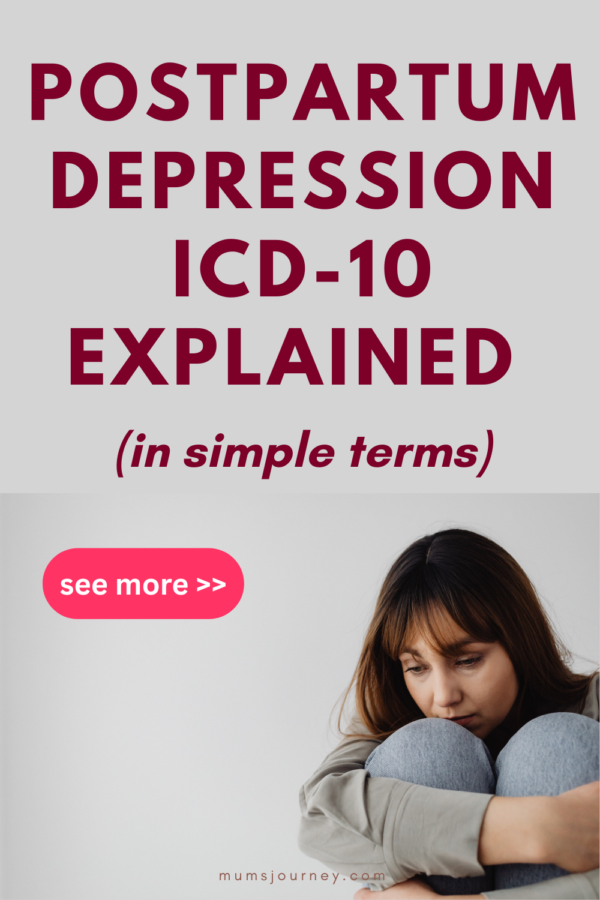
If you’re also wondering what Postpartum Depression ICD-10 means, you’re in the right place!
In this post, I explain it in a simple way:
- what Postpartum Depression ICD-10 means in simple terms
- what ICD-10 is (explained without medical jargon)
- the official ICD-10 code for postpartum depression
- common symptoms of postpartum depression
- what it means for you and your care
But first, hello!
I’m Ivana, a mum of three boys (including twins), the founder of MumsJourney, and author of Motherhood: The Unspoken, on a mission to create a world where mums feel seen and supported.
After having our twins in 2016, I had severe postnatal depression. It was the worst time of my life I don’t wish on anyone. But it also helped me realise how many (new) mums struggle in silence.
After I recovered from PPD, I started this blog to help other mums so they never feel alone in what they’re going through.
Now, let’s talk about what postpartum depression is, and how it feels.
What is postpartum (postnatal) depression?
Postpartum depression (also called postnatal depression or PPD) is a type of depression that can develop after you have a baby.
It’s more than just feeling tired or overwhelmed – which most new mums expect to some degree.
This goes deeper and affects how you feel, how you think, and how you cope with everyday life.
There are many ways postpartum depression can show up. For example, you may feel:
- disconnected from your baby
- disconnected from yourself
- numb
- hopeless
- very low
- constantly worried
- like you’re just going through the motions
- thoughts of hurting yourself or your baby
Postpartum depression doesn’t mean you are not happy about having a baby.
It is also not a sign that you’re failing as a mum or as a human being.
PPD is not something you can just push through or switch off.
It’s a health condition that requires support and, in many cases, professional treatment.
It can develop gradually over time or come on quite quickly after birth, and it can look different for every mum.
If any of this sounds familiar, you are definitely not alone in how you’re feeling – and help is available to you.
See also my posts:
- What is postnatal depression: Everything you need to know
- 10 Postpartum Depression Signs and Symptoms (What No One Tells You)
- How Long Can Postnatal Depression Last (And Will It Ever Go Away?)
- Postpartum Depression and Treatment Options: A Complete Guide
- Postnatal Depression 6-9 Months After Birth: Why It Can Appear Later Than You Think
What is ICD-10? (simple explanation)
ICD-10 is a term used in healthcare that most parents or the general public wouldn’t normally come across.
It stands for International Classification of Diseases, 10th Revision.
It’s a system doctors and healthcare professionals use to group and label health conditions in a consistent way.
Think of it like a very large reference book.
Every illness or condition has its own code, so doctors anywhere in the world can understand exactly what is being talked about without confusion.
So instead of writing long descriptions like “postpartum depression after childbirth”, they use a short code instead.
It makes record keeping easier and helps with diagnosis, treatment, and medical support.
That’s all.
It’s a system doctors use to organise health conditions so they can understand each other clearly and make sure people get the right help.
What is the ICD-10 code for postpartum depression?
When it comes to postpartum depression, doctors usually use a specific ICD-10 code to record it.
The most common one is F53.0.
This code is used for mild mental and behavioural disorders associated with the postnatal period.
In simple terms, it refers to postnatal depression that happens after childbirth.
Sometimes, depending on your symptoms, healthcare professionals may also use other codes such as F32 (depressive episodes) or F33 (recurrent depression).
It really depends on the individual situation and how you’re assessed.
These codes are not there to label you or define your experience.
They are simply used so doctors can record what’s happening and make sure you get the right support.
In other words, it helps make sure nothing gets missed.
It simply means your experience is being recognised within a system so you can get the right care and support.
What this means for you (as a mum)

PhDr. Ivana Poku is the author of Motherhood – The Unspoken, an award-winning blogger and maternal mental health advocate. Through her work, she is on a mission to create a world where mums feel seen, heard and supported. Ivana is also a mum of three boys, including twins, and lives with her family in a small coastal town in Scotland.