

Last Updated on September 5, 2026 by Ivana Poku
Going back to work after maternity leave can be heartbreaking.
The closer the day comes, the more dread you feel in your heart.
And how could you not?
You carried your baby, gave birth to them and spent every moment with them for months.
How could you feel okay about suddenly cutting that time down by quite a lot?
You want more time with them because you know they’re only little once, so you want to be there for every moment.
I don’t blame you.
But truth be told, it’s not as simple as that.
While going back to work is hard and can feel unfair, it can also be beneficial for both you and your baby in many ways.
I explain how in this post. I will also share simple tips to make returning to work after maternity leave less stressful.
But first, hello! My name is Ivana, and I’m a mum of three boys (including twins), founder of MumsJourney, and author of Motherhood – The Unspoken.
I’m on a mission to create a world where mums feel seen and supported.
In this post, I cover:
- Why you feel sad or depressed about returning to work
- How to ease the transition
- What your rights are
- How to write a return-to-work letter
Let’s dive in!
Related posts:
- Career after motherhood: Best jobs that work around family life
- How I stopped feeling sad about my kids growing up
- Am I a good mum? Here’s the evidence you’re doing a fantastic job
Going Back to Work After Maternity Leave
While many people may see it that way, going back to work after maternity leave is not just a date in your calendar.
It’s a huge milestone that comes with a lot of conflicting emotions.
If you find the thought of leaving your baby harder than expected, please believe me, you’re not the only mum feeling this way!
Why You May Feel Depressed About Going Back to Work After Maternity Leave
Yes, it’s notally normal to feel sad or even depressed when you have to go back to work. Don’t listen to anyone who says otherwise!
Here’s what makes it so scary:
- The guilt of leaving the baby
- The fear of the unknown
- The loss of control
- Separation anxiety (yours, not just baby’s)
Often all at once!
Your sadness is real and not something to “get over” or “fix”.
It’s a natural part of transitioning into a new chapter.
Like any change in life, it takes time to adjust to it. But the good news is, you have already survived the biggest change in your life when you had your baby, so will survive this one too!
3 Tips for going back (when you feel emotionally unprepared)
Now, let’s take a look at how you can cope with how you feel.
Because while it’s all normal, it can be overwhelming and highly uncomfortable. Here are a few things that can offer quick relief so the sadness doesn’t take over your daily life or grow into something more serious.
1. Name Your Feeling
Say how you feel out loud or in your mind: I’m scared to leave my baby. I’m heartbroken. I’m anxious. When you name the feeling(s), it helps you distance yourself from them and take their power away. Do this and you’ll immediately feel part of the weight lifting.
2. Accept how you feel
I know you don’t want to feel sad or depressed, but the more you try to fight it, the stronger it becomes.
So a much better way is to simply accept that returning to work will feel uncomfortable for a while.
It’s supposed to.
You’re not a robot, you’re a mum with feelings.
We often see sadness, guilt, or fear as “bad”, but they are just signals – it’s how your mind and body communicate with you.
It’s a natural part of life. We often live under the impression we should avoid all bad feelings and only aim for the good ones. But that’s not how life works. You will experience both throughout life – and the sooner you accept it, the lighter you’ll feel.
Yes, it’s hard now but it won’t last forever.
3. Find your ground again
When you feel panic in your body, you need something that brings you back down.
This can be anything that works for you but the simplest one I know is affirmations.
Not the fluffy kind that make you feel like you’re lying to yourself – the kind that make you feel steadier, like you can do this.
And the best thing is you can come back to them any time you need:
- In the car before you walk in
- In the work toilets
- At 3am when your mind won’t switch off
I wrote 19 calming affirmations for exactly this stage. You can grab them here for free.
Surviving Returning to Work After Maternity Leave
Now that you’ve found some relief, let’s take a look at what can make the transition less painful long term:
1. Reframe the Story
Whenever you face a problem, it’s never the actual problem that causes how you feel. It’s how you see the problem. If you change the way you look at it, it can change everything. So, for instance, instead of “I’m abandoning my baby”, try:
- “I’m showing my baby resilience.”
- “I’m modelling to them that you don’t need physical presence to feel loved.”
- “I’m teaching them (and myself) independence.”
- “My brain tells me I’m abandoning my baby, but I choose not to believe it.”
- “I know that having some time apart will allow us to have more quality time together.”
- “I will be more relaxed when I have some space and do something just for me.”
See how one small shift can change how you feel? You’re not lying to yourself, you’re just choosing a different angle to focus on. Not to mention that you going back to work really is beneficial for you both. I’ll talk about it more in a moment.
2. Simplify Your Life
If you try to do 10 things at once, it doesn’t serve anyone – least of all your child(ren). Try:
- Meal prep or batch cook at weekends
- Use grocery delivery
- Lower house standards
- Organise your home
- And most importantly – ask for help like it’s your job!
Remember that asking for help is not weakness, it’s smart.
And it makes a massive difference in how you feel. Personally, asking for help when I was recovering from postpartum depression saved me in so many ways. The only thing I regret is that I didn’t ask for help earlier.
If you find it hard to keep your home tidy and organised (side note: MANY mums do), make sure to also check out my post How to stay organised as a (new) mum: Declutterring expert shares what actually helps.
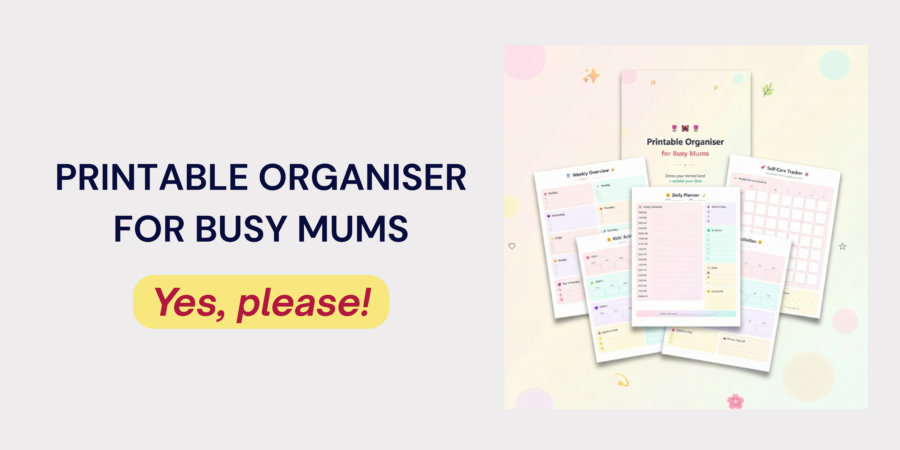
And if you want something tangible right now, you can also grab my free printable organiser for busy mums.
3. Talk to Your Employer
It can feel scary to talk to your employer about how you feel.
But remember – they want you to succeed too.
It’s in their interest as much as yours. No manager wants someone struggling in silence until it starts showing up in their work.
They’d much rather know, so they can actually do something about it.
And you might be surprised how much support you get just by being open – with your employer, and with yourself.
4. Connect With Other Working Mums
Speaking to other mums who are in the same situation can be one of the most powerful sources of support.
Why?
Because they’re the only people who understand exactly how you feel.
So reach out to mums (offline or online) who are also going back to work and talk to them, ask them questions, and share how you feel.
There’s nothing better than hearing “Me too!” when we’re struggling.
Related posts:
- It Takes a Village: How to Create Your Own Mum Community
- 7 Simple ways to make mum friends (even if you’re an introvert)
- Why talking about mum stress might be the best thing you ever do
Let’s Talk About Your Rights
Now, let’s look at your rights.
Trust me, knowing your rights can save you a lot of stress.
Here are the protections you get under UK law when you return to work after maternity leave:
1. You Have the Right to Return to Your Job
If you take up to 26 weeks of leave, you get your exact same job back. If you take longer than 26 weeks, your employer must still try to give you the same job. If that’s truly not possible, they must give you a similar one, with the same or better terms. Read more on GOV.UK.
2. You Can Ask for Flexible Working From Day One
You can request flexible working from your very first day in a job – you don’t need to have been there any length of time. This can mean:
- a phased return
- fewer hours
- or working from home some days.
You can make up to two requests in any 12 months and your employer must give you an answer within two months. Read more on GOV.UK or ACAS.
3. You’re Protected If There’s a Redundancy
This one can give you real peace of mind. If your job is at risk while you are on maternity leave or after you go back to work, your employer has to offer you an alternative job before other people.
This protection starts when your maternity leave begins and lasts until 18 months after your baby is born.
You can read more on GOV.UK or Maternity Action.
4. You’re Protected From Unfair Treatment
Pregnancy and maternity are protected under the Equality Act 2010. So it’s against the law for your employer to treat you badly because you had a baby or took maternity leave. Personally, I am so happy about this law! I had my boss shouting at me when I was pregnant with my third, but sadly, I didn’t know about this law back then. Read more on Citizens Advice or the Equality and Human Rights Commission.
5. You Can Use Keeping in Touch (KIT) Days
This is another great way to ease into going back and make the transition less shocking to your system: Keeping in Touch (KIT) days. It means you can work for up to 10 paid days while you’re on maternity leave without ending your leave early.
You need to agree with your employer before you work any of them.
Read more on GOV.UK. These are general rights, not legal advice for your personal situation. Laws can change, so always check the latest information on GOV.UK. You can also speak to ACAS or Citizens Advice if you need any help or advice.
Writing a Return to Work After Maternity Leave Letter
Ok, let’s move on to how to write a letter to your employer.
This often feels more complicated than it actually is.
Here’s what I suggest:
- Start with something positive: for instance, thank your employer for the maternity leave and support
- Say clearly when you’ll be coming back to work
- If you need any flexibility, explain why
- Let them know you’re committed and ready to come back
- Keep it short and sweet: just one paragraph or a short page is perfect.
Example: “Dear [Manager’s Name], I hope you’re well. I’m writing to confirm my return to work after maternity leave on [date]. I truly appreciate all the support I’ve received during my leave and look forward to rejoining the team. As discussed, I’ll start with [flexible arrangement if applicable]. Many thanks for your understanding and support.” That’s it! Easy peasy.
The Good Side of Going Back to Work
Now I want to say something you might not be ready to hear yet.
If you’re not, feel free to skip this bit and come back to it another time.
But when you are ready, here it is: going back to work has real benefits. For you, and for your little one.
Here are some of them:
- You teach your child independence: While it may sound cute to always be there for your baby, our job as mums is to teach them to thrive without us. Time apart is how they start learning this crucial life skill.
- You make things easier for yourself long term: Similarly, having a break from them is good for you too. You still need your own life, your ME time, and your dreams. If you let all that go, you’ll have a much harder time further down the line. See also my post How I stopped feeling sad about my kids growing up “too fast”.
- It makes you a better mum: Let’s be honest, being a mum is not easy, and when you’re with them all the time, it takes a toll on your nervous system. It’s not about how much time you spend together, but how good that time is. Believe me, 20 minutes a day of a happy, present mum gives them MUCH more than a whole day of you being stressed or distracted.
- You show them it’s ok to be apart, and that it doesn’t cancel out love: If they only felt loved when you were right there in the room, life would be very hard for both of you.
- It’s a chance to find a job that fits your new life: Going back doesn’t have to mean going back to the exact same job. Motherhood changes what you actually need and want from work, and this is the perfect time to ask whether your current role still fits your. If it doesn’t, don’t be afraid to explore other options! I share best jobs for mums that work around family life in this post.
Final Word
There you have it, lovely one.
I know that going back to work after spending months or years with your baby is very heartbreaking, but you will adjust.
You’re definitely not the only one going through this.
Remember that your baby doesn’t need you every minute of the day.
In fact, it wouldn’t do them any good – and it wouldn’t be good for you either.
You both need some time apart to grow, learn, and thrive in your own ways.
Make sure to look after yourself and talk to others about how you feel – ideally mums in the same position.
And if you need extra help, ask for it!
Asking for help doesn’t mean you’re weak, it means you choose to remain strong.
If you have any questions, drop them in the comments below or email me at ivana.poku@mumsjourney.com. I love hearing from my readers! 🙂
FAQs
1. Why don’t I want to go back to work after maternity leave?
Many mums feel they don’t want to go back to work after maternity leave because they are still adjusting emotionally to motherhood (especially mentally). The bond with a new baby is incredibly strong, and the idea of separation can trigger sadness, anxiety, or guilt. These feelings are common and many mums find they become easier to manage with time and the right support.
2. Is it normal to feel guilty about returning to work after maternity leave?
Yes, completely. Many mums feel guilt, sadness, or anxiety when leaving their baby for the first time. These feelings are a normal part of transitioning into a new routine and don’t mean you’re a bad mum.
3. How long does it take to adjust after returning to work post-baby?
Every mum is different, but it typically takes a few weeks to a couple of months to settle into a new rhythm. Be patient with yourself – adjustment is a process, not a switch.
4. How can I manage anxiety about leaving my baby?
Start with short separations, create comfort rituals, talk about your feelings, and consider seeking professional support if anxiety becomes overwhelming. You’re not alone, and there is help available.
5. What should I include in a return-to-work letter after maternity leave?
Keep it short and professional. Include your return date, any flexible working requests, and a note of thanks for the support during your leave.
6. Can I ask for flexible working after maternity leave?
Yes! You can formally request flexible hours, a phased return, or remote working. Many employers are open to these arrangements, especially when approached with honesty and a clear plan.
7. What if I don’t feel ready to return to work after maternity leave?
That’s okay. If possible, talk to your employer about adjusting your return date or hours. If the feelings persist, it might be worth speaking to a doctor, GP, or mental health professional for support.
Your next read:
- Easy Meals for New Mums: 10 Recipes You Can Make in 20 Minutes or Less
- How to Cope With Postpartum Sleep Deprivation (Without Losing Your Mind)
- 5 Simple ways to find peace as a stressed mum
- 8 Things I Tell My Kids When Other Kids Are Rude to Them

PhDr. Ivana Poku is the author of Motherhood – The Unspoken, an award-winning blogger and maternal mental health advocate. Through her work, she is on a mission to create a world where mums feel seen, heard and supported. Ivana is also a mum of three boys, including twins, and lives with her family in a small coastal town in Scotland.