Last Updated on September 10, 2026 by Ivana Poku
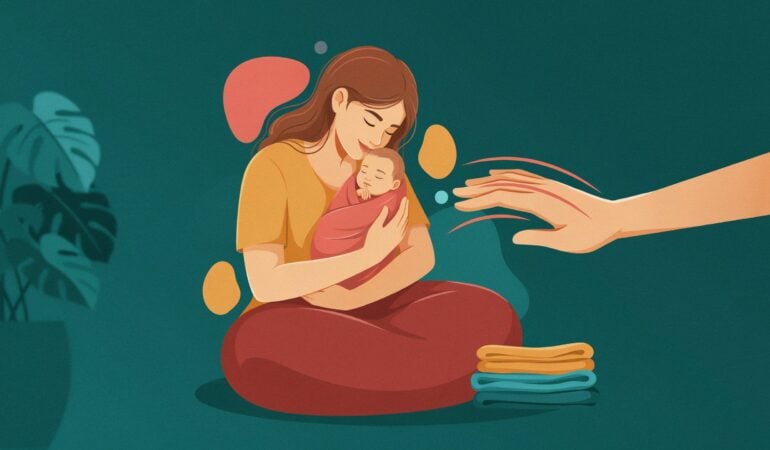
You know the moment when your partner reaches over in bed and… pats you?
Like you’re a sofa cushion he’s fluffing up.
Or, in a better case – a dog.
When that happens, something in you (or all of you) wants to scream.
Not because he’s touching you, but because how he’s touching you.
You brain goes: No. Not. like. that.
I get it, my lovely.
And I can reassure you’re not alone feeling like this.
Something very real happened to you.
Let’s talk about it.
When Touch Has Changed
Before you had children, touch was just touch:
- a hand on your back
- a hug
- a pat on the arm from a friend
It felt good, but you didn’t give it much thought.
And now, every touch gets filed and sorted:
- Is it heavy or light?
- Does it ask something of me?
- Is this another person who needs me to respond?
In other words, when you became a mum, your nervous system has turned into wide open door.
Before baby, that door only opened sometimes. Now it’s open all day, every day.
Still doesn’t make much sense?
Ok, imagine there’s a bouncer standing at that door.
His job is to guard it and he does it all day. By the evening, he’s so exhausted that he starts saying “no” to everyone because it’s easier.
The bouncer is your nervous system.
That’s why you flinch when your partner pats your arm.
It’s your bouncer worn out from saying “yes” all day.
You may also like:
- Why I Put My Relationship BEFORE My Children (And Why That’s Actually Good for Them)
- Default Parent: Why You’re the One Who Remembers Everything
- How to get your partner to help with the baby (the ONE way that actually works)
What Is “Touched Out,” Really
You’ve probably heard the phrase touched out before.
Or maybe you’ve even said it yourself – half-joking, half-desperate.
Let’s take a look at what it means, because there’s more to it than just “tired of touch.”
Here’s what touched out can feel like:
- A baby latched on your chest for the fourth time today
- A toddler hanging off your leg while you try to cook
- Your child’s hands patting your face, your hair, or your shirt
- Someone climbing onto your lap the second you sit down
- A partner reaching for you, wanting closeness
None of it is bad.
But your body has been available all day.
Available to be climbed on, leaned on, nursed from, patted, tugged, needed…
And light touch and firm touch feel completely different to a tired body.
Even a soft pat feels like a question: are you there? can I have you?
Firm touch is different:
- A big hug
- A deep squeeze
- A firm rub on the back
That kind of touch doesn’t ask you for anything, it just says I’m here.
As opposed to a soft touch, it calms your body down.
That’s the thing behind “rub me, don’t pat me.”
It doesn’t mean you’re fussy, it’s how you’re wired.
What Actually Helps
Here are a few things that can help you feel less touched-out, and help your partner understand what’s going on:
1. Tell him how a pat makes you feel
Don’t assume he knows how you feel. (He doesn’t.)
Tell him.
You can say: “I love you, but I feel___________.” Don’t blame him, just honestly explain why his touch makes you feel the way it does.
It works much better than staying quiet or hoping he “just gets it”. (He won’t.)
He’s not trying to irritate you, he genuinely doesn’t know that the difference between a pat and a hug is doing anything at all.
2. Tell him what you want instead
Instead of telling him what not to do (“Don’t touch me,”), tell him what to do.
For instance: “Can you just hold me for a second, properly, no patting please.”
Specific requests are easier for someone (especially men) to meet than hints – or silence.
3. Build in touch-free windows
If you can’t remember the last time you had ten minutes without someone touching you, make it happen. Don’t wait for it to appear.
You know how men disappear into the toilet for ages, not really doing anything, just taking space? It’s annoying, but also smart. So lock yourself in the bathroom and don’t come out for at least thirty minutes. Kidding! (Mostly.)
Any kind of break works, as long as you’re alone and you actually use it as a break. (Actually, thinking about it – the toilet might genuinely be the best bet.)
4. Find a solution together
Talk to your partner about this and find a long term solution together. So that you don’t flinch when he touches you, and he doesn’t feel like he’s done something wrong.
This one sounds obvious, but you’d be surprised how many couples skip it. They complain to a friend, rant in their head, curse under their breath…. But they never actually talk to the one person who could do something about it.
It’s very important you talk without blame and criticism. Remember, you and your partner are a team.
And now that you’re parents, looking after that team matters more than ever. In fact, I believe your relationship should come before your children.
You’re Teaching Your Children a Life Skill
Now, there’s one more important thing I need to say:
Your’re constantly modeling to your children.
When you speak up about what your body needs, you’re teaching them a life skill.
You’re showing them they get to say “not like that, like this instead” about their own body.
You’re also protecting your relationship.
If you don’t communicate, resentment can build and do a lot of damage over time.
Before you know it, you’re living side by side, but feeling more like housemates than partners.
It happens very often.
My husband and I have a very strong relationship, but becoming parents brought a few hard patches that shook us too.
If you want to know what helped us get back on track, I share it in my FREE Relationship Survival Guide.
Final Word
Here’s the truth, my lovely.
This won’t fix itself overnight – and it doesn’t need to.
Some evenings you’ll still flinch, some you’ll want to be held, and some you’ll want nobody near you.
It’s all okay.
But knowing why it’s happening, and how you can start shifting it, changes things.
“Rub me, don’t pat me” isn’t fussy – it’s you, finally speaking the language your body’s been trying to speak all along.
You’re allowed to ask for touch that settles you. Always.
You’re not being difficult or dramatic, you’re respecting your body and your needs.
If you have any questions at all, please drop them in the comments or email me at ivana.poku@mumsjourney.com. I respond to all my readers.
In the meantime, here are most posts I think you’ll enjoy:
- Relationship After Kids: Expert Tips to Feel Close Again
- How to Put Yourself First As a Mum (Without Guilt)
- When Your Partner Becomes Super Dad: A Real Talk Guide for New Mums Who Feel Overlooked

PhDr. Ivana Poku is the author of Motherhood – The Unspoken, an award-winning blogger and maternal mental health advocate. Through her work, she is on a mission to create a world where mums feel seen, heard and supported. Ivana is also a mum of three boys, including twins, and lives with her family in a small coastal town in Scotland.